
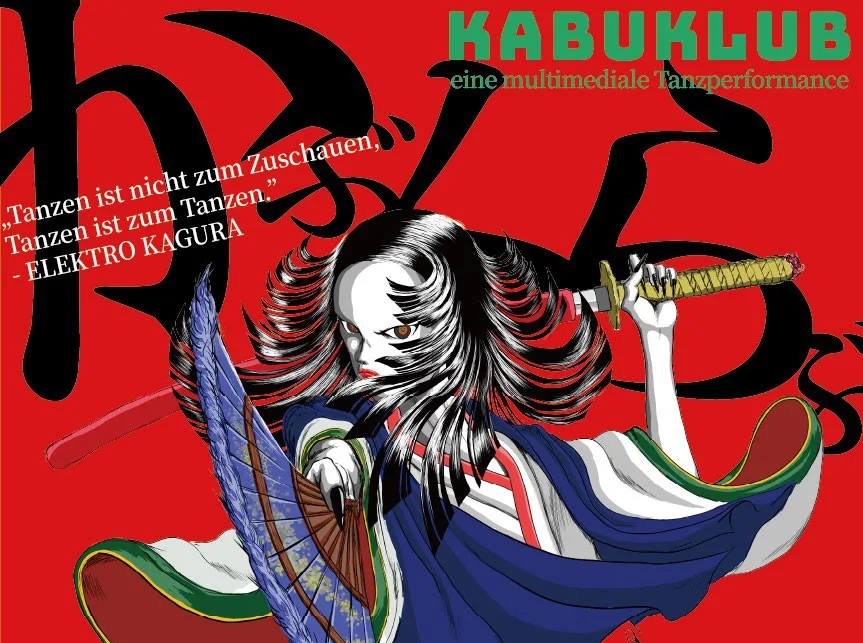
In 2025, Elektro Kagura developed the dance theatre piece *KabuKlub*, in which the audience joins in the dancing. The original concept draws on the legacy of Okuni (1572–1613?), who is regarded as the founder of Kabuki. She broke down the barrier between the audience andthe performers, so that in the end everyone took part in her dance performance. Okuni drew inspiration from the so-called Kabuki Gays, who were known in medieval Japan for their extravagant, punk-style, comical and eye-catching costumes and behaviour. From today’s perspective, the origins of the Japanese performing art of Kabuki were remarkably contemporary – and it was a woman who brought Kabuki to life. She began by dancing on the riverbank in Kyoto, attracting ever-increasing crowds, and eventually formed her own troupe. In the end, she even danced provocatively and confidently before the shogun, the head of the samurai, thereby pitting her life and her art against the established powers. We see strong parallels between this early Kabuki era and Berlin’s club culture. In our piece, we jump between the Middle Ages and the present day, between Japan and Berlin, and bring these worlds together. We also want to use this project to strengthen local ties in Lichtenberg. That’s why we’re looking for participants who live in Lichtenberg and would like to dance or play music as part of Okuni’s troupe. If anyone is interested, we’d be delighted if you got in touch with us!
There is a scene involving free-form dancing, as well as other scenes with simple choreography. Just get in touch with us!
Email: elektrokagura.e.v@gmail.com
By & with Elektro Kagura | Yukihiro Ikutani | Ichi Go | Cédric Douhaire | Ryota Maeda | Yvonne Leppin | Olga Simchuk | Laura Sophie Heise | likabari, Gałgał | Lena Hoepfner | Karim Karel | Andreas Heilig | Mayuko Hiramatsu | Betty Despoina Athanasisdou | Udo Wiegand | Theo Tranca | Joshua Remsanga Sailo
Dates
- Friday, 03. July 2026 – 07:00 PM
- Saturday, 04. July 2026 – 07:00 PM
