
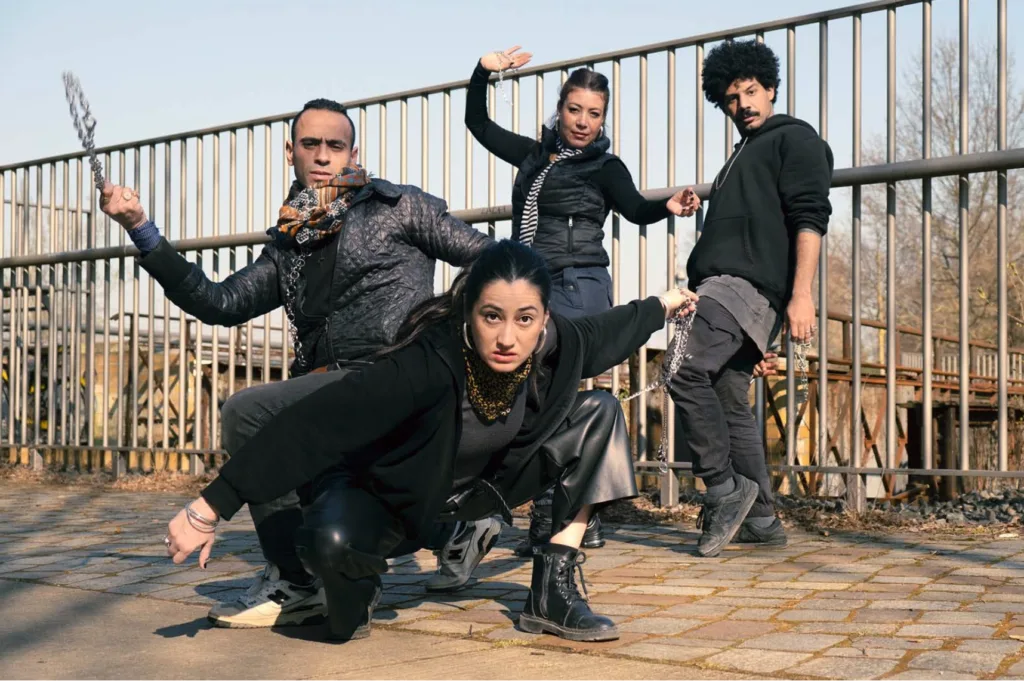
A dance performance, sharp as a knife and strong as a heartbeat-
Knife Hearts is an international co-production between Egypt and Germany, bringing together four
dancers — three Egyptian and one German-Turkish. They challenge Western definitions of dance
and performance, as well as the expectations imposed on them. Drawing on the long tradition of
Raqs Sharqi (belly dance) and Mahraganat (Egyptian street dance), as well as blending urban
dance practices from Egypt and the region, the performers expand and reconfigure the vocabulary
of contemporary dance.
The performance engages with Mahraganat, a burgeoning music and dance genre which literally
means ‘festivals’. Often described as an Egyptian adaptation of hip-hop, shaabi music, rap and
electronic dance music, Mahraganat blends these influences into an intensely festive context that
celebrates marginalised bodies. Emerging in the urban outskirts of Cairo, Mahraganat represents
and speaks to communities that are often marginalised, stigmatised or labelled as dangerous.
Despite strong social stigma and repeated attempts by the state to suppress it, Mahraganat has
disseminated significantly and grown in popularity across the region and globally over the past
two decades.
By using Mahraganat dramaturgically, the dancers challenge social scripts in both Egypt and Ger-
many, creating a performance that raises challenging questions: Who gets to perform, and why?
What happens when dance is displaced from its original context? What is the role of the audience
in receiving and interpreting a dancing body?
In a climate of growing discrimination and racial violence against those bodies perceived as Arab,
Turkish, or Muslim–as well as those affected by classism–Mahraganat may well offer a different
way of seeing things. Within the Mahraganat movement’s dance vocabulary, there are recurring
dance motifs that imitate fighting and the use of knives and fire. This ritualised choreography
speaks of virtuosity and control, but also of how dance can facilitate the avoidance and mediation
of conflict. People dance to avoid fighting, transforming gestures of aggression into shared
moments of connection and sublimating violence into the possibility of to-getherness and celebration.
Direction | Choreography | Performance Islam Elarabi, Sherin Hegazy, Tümay Kılınçel, Mohamed Toto
Dramaturgy Ismail Fayed
Lighting design Catalina Fernández
Set design Cheng-Ting Chen
Musical direction & co-composition Dmitrii Makhonin
Music production Ali Elharam
Graphic design & key visual Nedal Dewary
Video & photo documentation Nataliya Nikolska
Audio description Emmilou Roessling
Co-author of audio description Silja Korn
Artistic production manager Urszula Heuwinkel
Assistant artistic production manager Onur Agbaba
Production Islam Elarabi, Tümay Kılınçel
Co-production FFT Düsseldorf, Künstler*innenhaus Mousonturm
Supported by Goethe-Institut – International Co-Production Fund (IKF), Capital City Culture Fund,
Department of Culture of the State Capital Düsseldorf, Kunststiftung NRW, City of Frankfurt am Main, NRW State Office for the Independent Performing Arts e.V.
With the kind support of the theaterhaus berlin
Dates
- Thursday, 11. June 2026 – 07:00 PM
- Friday, 12. June 2026 – 07:00 PM
- Saturday, 13. June 2026 – 07:00 PM
- Sunday, 14. June 2026 – 07:00 PM
